Death Order by Needle Jan
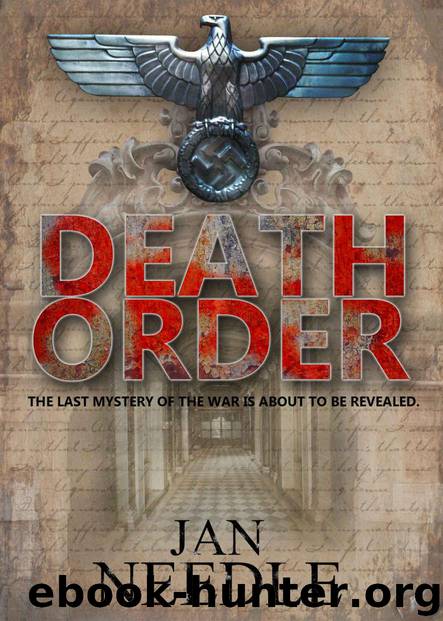
Author:Needle, Jan [Needle, Jan]
Language: eng
Format: azw3
Publisher: Endeavour Press
Published: 2015-04-20T16:00:00+00:00
Nine
The beauty of that late summer came to seem, finally, quite bizarre. Although most people were relieved that the waiting game was over, the first days and nights were nerve-racking. All the preparations, all the propaganda, had led them to expect Herr Hitler to start it with a bang, an airborne cataclysm, probably with fire and with deadly gas. Although few people still retained the Great War view that German soldiers wore dead babies on their helmet spikes and lived on human flesh, there was little doubt in many minds that the Führer was related to the devil. It was a schizophrenic view, as he was depicted by cartoonists as a buffoon, a cringing halfwit with cap constantly in hand, but the balloons, the sandbags, the innumerable air-raid shelters attested to the underlying fear. And nothing came. The war in Poland raged tragically, but even the French had pulled themselves together sufficiently to coin triumphalist slogans about their might and will. It continued warm and pleasant, no bombers terrified or destroyed, and euphoria returned and grew. Not until October 14, when a U-boat penetrated the defences of Britain’s ‘safest harbour’ at Scapa Flow and killed the Royal Oak and more than eight hundred of her sailors, did the chill of autumn begin to bite. Churchill, the First Sea Lord and England’s hero, could only describe it in the House on October 17 as ‘a remarkable exploit of skill and daring’. There were many more to follow.
For Edward, the early weeks brought little but frustration and disappointment. He had learned from Desmond Morton that there was a plan afoot involving iron ore and the Swedish port of Oxelösund, which – had he not ‘joined the wrong eleven’ – he might have had a hand in. Edward knew Oxelösund, and guessed that the idea might be to cripple it, to cut down ore shipments to German industry, although Morton would not confirm his hunch. The major, grander now but no less approachable, had been promoted to a joint directorship of the Ministry of Economic Warfare.
‘Try for a transfer, my lad,’ he said. ‘It might sound damned stuffy but it’s not. Winston calls it the Ministry of Ungentlemanly Warfare, you know, although we have no riffraff, naturally. We get up to all sorts, I can tell you, and we’re not fully in our stride yet. God knows what’ll happen now that poor old Quex is going home. Perhaps I’ll put in a word for you sometime.’
Quex was dying, fast, of cancer. By October his days in the saddle were over, and his deputy, Lieutenant Colonel Stewart Menzies, was preparing to clear his desk for one last time and transfer to Sir Hugh’s enormous office overlooking Whitehall, an office so secret that it had a private door and staircase that could not be overlooked. There were some who hoped and half expected that he would never get there, and indeed, fought viciously to prevent it. Not because of his background – among Menzies’ credentials
Download
This site does not store any files on its server. We only index and link to content provided by other sites. Please contact the content providers to delete copyright contents if any and email us, we'll remove relevant links or contents immediately.
In Control (The City Series) by Crystal Serowka(36197)
The Wolf Sea (The Oathsworn Series, Book 2) by Low Robert(35211)
We Ride Upon Sticks by Quan Barry(34493)
Crowbone (The Oathsworn Series, Book 5) by Low Robert(33589)
The Book of Dreams (Saxon Series) by Severin Tim(33349)
The Daughters of Foxcote Manor by Eve Chase(23583)
Trainspotting by Irvine Welsh(21606)
Call Me by Your Name by André Aciman(20462)
The Secret History by Donna Tartt(18993)
Shot Through The Heart (Supernature Book 1) by Edwin James(18899)
All the Missing Girls by Megan Miranda(15881)
The Girl from the Opera House by Nancy Carson(15760)
American King (New Camelot #3) by Sierra Simone(15748)
Pimp by Iceberg Slim(14461)
Sad Girls by Lang Leav(14382)
The Betrayed by Graham Heather(12800)
The Betrayed by David Hosp(12752)
4 3 2 1: A Novel by Paul Auster(12352)
Still Me by Jojo Moyes(11238)
